
An Elementary Reset
- Al Felder

- 1 day ago
- 4 min read
What School Could Look Like If We Prioritized Movement, Play, and Mastery Over Test Prep
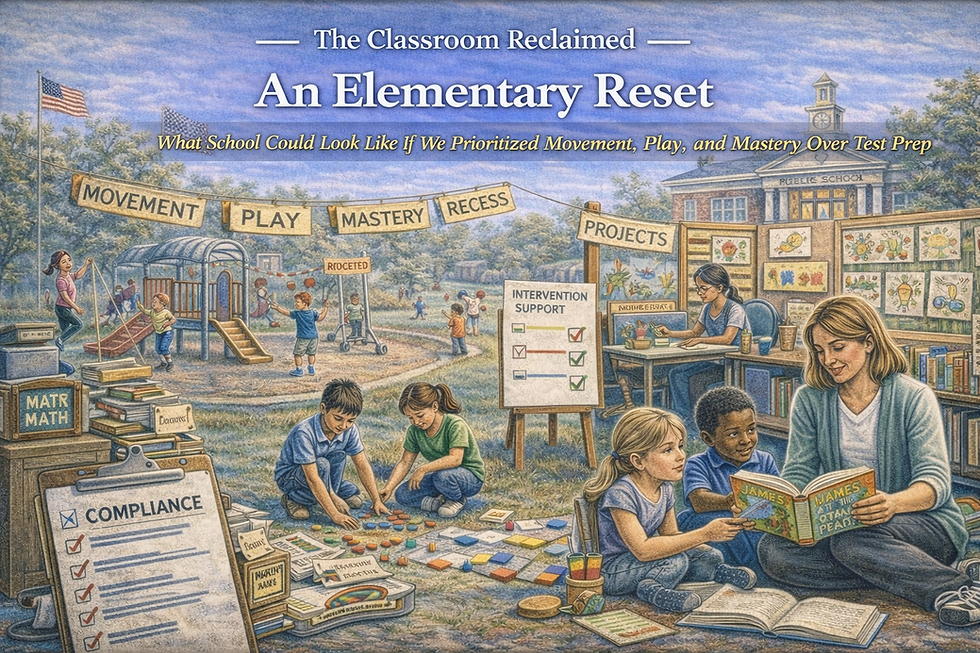
If you ask elementary teachers what young children need most, you’ll hear the same themes again and again:
movement,
repetition with purpose,
conversation and language-rich classrooms,
joyful practice,
relationships,
and time.
If you ask many policy systems what elementary schools need most, you often hear a different answer:
more data points,
earlier testing windows,
tighter pacing,
more intervention documentation,
and stronger compliance mechanisms.
That mismatch is one of the biggest problems in modern public education.
If Mississippi is serious about improving outcomes, we need an elementary reset—a model that aligns with how children actually learn while still preserving meaningful accountability.
This is not a call to lower standards. It is a call to use better methods.
The core principle: Young children learn through active development, not passive compliance
Elementary-aged children are still developing:
attention span,
self-regulation,
language fluency,
motor coordination,
social-emotional awareness,
and academic stamina.
That means the school model matters as much as the standards themselves.
When early learning becomes dominated by seat time, screens, and constant assessment cycles, we often get:
weaker engagement,
more behavior challenges,
shallow retention,
and a false sense of rigor.
Rigor is not how still a child sits. Rigor is the depth of a child's understanding.
What an elementary reset would include
1) Protected movement and recess as instructional priorities
Movement is not a reward after learning. For young children, movement supports learning.
A reset model would include:
daily protected recess that is not routinely removed for academics or punishment,
frequent classroom movement breaks,
kinesthetic learning routines in reading and math,
reduced dependence on prolonged passive seat time.
If we want better focus and stronger learning stamina, we should design for the brain and body we actually have—not the one we wish children had.
2) Foundational literacy and numeracy taught with depth, not rush
An elementary reset keeps high expectations but slows the pace of panic.
Literacy priorities
explicit foundational skills,
rich read-alouds and vocabulary work,
fluency development with meaningful text,
comprehension through discussion and writing,
intervention that is timely and practical.
Math priorities
number sense and conceptual understanding,
fact fluency built through practice and strategy,
hands-on models before abstract shortcuts,
problem-solving talk, not just answer-getting.
Mastery beats coverage. Children need to understand deeply before moving quickly.
3) Less test prep, smarter assessment
Assessment should inform teaching, not consume it.
A reset would:
reduce high-stakes pressure in elementary grades,
use short, targeted checks tied directly to instruction,
avoid redundant testing windows that duplicate the same information,
limit screen-heavy assessment load for young learners,
streamline documentation, so teachers spend more time responding than reporting.
The key question is simple: Does this assessment help tomorrow’s lesson? If not, it may be noise.
4) Intervention that is immediate, human, and sustainable
Intervention fails when it becomes paperwork-first.
A reset model would prioritize:
fast support after the need is identified,
protected intervention blocks in the schedule,
trained intervention staff and manageable caseloads,
regular communication with families in plain language,
progress checks that guide decisions without overwhelming teachers.
If we identify needs but do not provide capacity, we create frustration—not progress.
5) A broader elementary curriculum, not a narrowed one
Elementary students need more than tested subjects.
A healthy model protects access to:
science,
social studies,
art,
music,
library,
PE,
and exploratory learning.
Why? Because these areas build vocabulary, curiosity, background knowledge, and motivation—the very foundations that support literacy and long-term achievement.
When we narrow the curriculum to chase scores, we often weaken the system that produces real learning.
6) Teacher professionalism and planning time restored
No elementary reset works unless teachers have:
protected planning time,
reduced documentation overload,
practical coaching support,
and flexibility to respond to students in real time.
Teachers are most effective when treated as professionals, not script-followers.
If policy demands continue to grow without reducing existing burdens, even the best reset vision will fail in implementation.
A sample “reset” elementary day
Here’s what a more developmentally aligned day could look like (example framework):
Morning arrival + relationship routines
Literacy block (explicit instruction + small groups + read-aloud/discussion)
Movement break
Math block (conceptual mini-lesson + hands-on practice + problem talk)
Recess (protected)
Science/Social Studies integrated with literacy/writing
Lunch + transition movement
Intervention/Enrichment block (targeted support without stigma)
Specials (PE/Art/Music/Library rotation)
Closing reflection/read-aloud
This kind of structure can maintain rigor while matching child development.
What accountability would look like in this model
An elementary reset does not eliminate accountability. It improves it.
Better elementary indicators:
growth in foundational literacy/numeracy,
attendance and engagement trends,
intervention responsiveness and recovery rates,
school climate and behavior stability,
access to a full curriculum,
teacher retention in early grades.
This gives families and policymakers meaningful transparency without reducing childhood to a test score cycle.
What policymakers would need to do
To make an elementary reset real, state leaders should:
Reduce redundant assessment mandates in K–5.
Protect recess and movement expectations in policy guidance.
Fund intervention capacity, not just identification requirements.
Streamline reporting requirements to reduce teacher paperwork load.
Include developmentally appropriate practice indicators in accountability frameworks.
Support training aligned to early childhood learning science.
Without policy alignment, districts are forced to choose between compliance and best practice.
What district leaders can do now
Even before state changes, districts can take meaningful steps:
protect recess in local schedules,
reduce local testing redundancies,
audit K–5 documentation requirements,
train leaders to look for deep learning in quiet classrooms,
prioritize early-grade teacher retention and support,
communicate the reset vision clearly to families.
Elementary schools improve fastest when adults share a coherent model.
A balanced takeaway
An elementary reset is not nostalgia. It is not anti-accountability. It is not “going soft.”
It is a practical shift toward methods that fit child development and improve real learning:
more movement,
better instruction,
smarter assessment,
stronger intervention,
fuller curriculum,
and sustainable teaching.
If we want stronger long-term outcomes, we should stop building elementary schools around test logistics and start building them around how children actually learn.
Reflection question for readers
If we redesigned elementary school from the ground up around child development, which current practices would we keep—and which would we finally let go?


Comments