
Teacher Retention in a Mandate-Heavy System
- Al Felder

- 1 day ago
- 4 min read
When Policy Load Becomes a Workforce Crisis

Every conversation about education eventually lands in the same place: “We need great teachers in every classroom.”
That statement is easy to say and hard to deliver—especially in a policy environment where demands keep increasing while support systems lag behind.
In Mississippi and across the country, teacher shortages are often framed as a pipeline problem: not enough people entering the profession. But for many districts, the deeper problem is retention—good teachers leaving because the job no longer feels sustainable.
HB0002IN sits inside that bigger reality. Whether you support the bill or oppose it, one truth remains: public schools are being asked to carry growing mandates, documentation, assessment cycles, accountability pressure, and public scrutiny—often with fewer people and less stability.
At some point, policy load stops being “reform.”
It becomes a workforce crisis.
The retention question policymakers avoid
Most policy debate asks:
What new requirement should schools implement?
What new report should districts file?
What new intervention plan should teachers document?
Far fewer ask:
What should we remove so teachers can keep teaching?
What burden is causing our strongest educators to leave?
How many mandates can one workforce absorb before it breaks?
Teacher retention is not only about salary. Pay matters—but workload, autonomy, respect, and sustainability matter too.
What “mandate-heavy” looks like in real school life
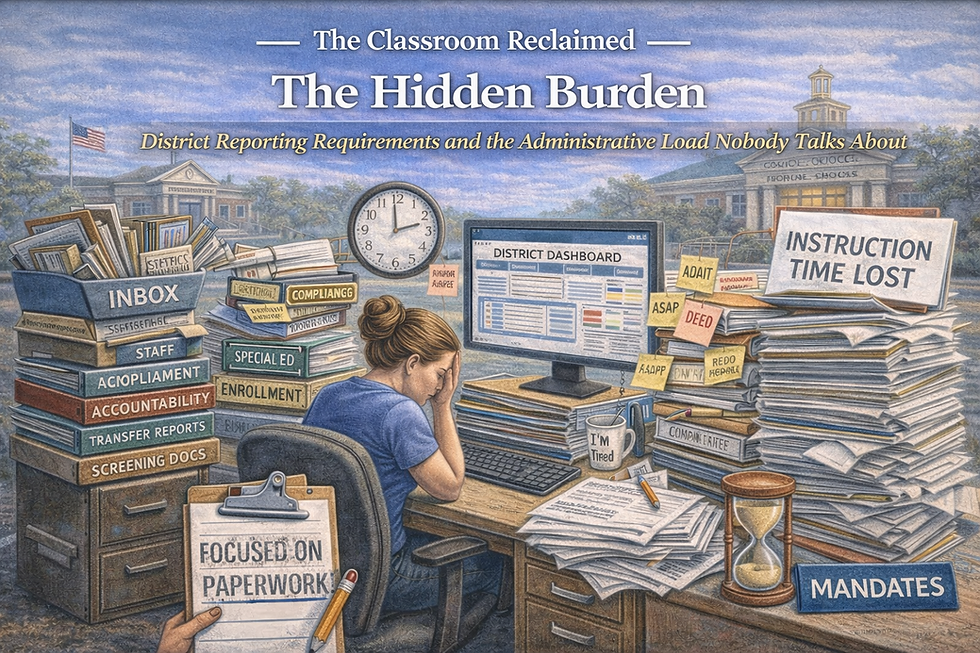
From a distance, mandates are bullet points in legislation. Inside schools, mandates become a daily strain:
expanded screening windows and data entry cycles
repeated intervention documentation requirements
increased parent communication logs and compliance artifacts
pacing pressures tied to external expectations
training rollouts that arrive without time to absorb them
shifting accountability targets from year to year
administrative tasks replacing instructional planning time
None of these alone is always unreasonable.
But together they create a reality where teachers feel like they are doing three jobs:
instructor,
compliance manager,
data technician.
And when that becomes normal, retention declines.
Why retention is now a systems issue—not an individual issue
When many teachers in many districts report similar pressures, this is no longer a “resilience” issue. It is a design issue.
Teachers leave when:
1) Workload outpaces capacity
Educators can handle hard work. What drives exit is endless expansion without subtraction.
2) Professional judgment is constrained
When scripted pacing and compliance controls replace teacher expertise, the job feels deprofessionalized.
3) Emotional load is relentless
Teachers absorb student trauma, family stress, behavior challenges, and academic recovery pressure—often without enough support.
4) Public narratives become hostile
When policy messaging implies that schools are failing regardless of their efforts, educators lose morale and trust.
5) Stability disappears
Frequent policy shifts make long-term planning difficult and increase burnout among teachers and leaders alike.
Retention falls when teachers conclude, “I can’t do this well and stay healthy.”
How HB 2-era policy pressures can amplify retention problems
In a mandate-heavy environment, HB 2-related dynamics can add pressure points:
additional screening/intervention requirements in key grade spans,
expanded reporting and administrative visibility expectations,
uneven accountability structures across educational sectors,
growing perception that public schools carry more regulation with fewer degrees of freedom.
Even when some components aim to improve outcomes, the cumulative impact can still be destabilizing for staff.
The issue isn’t whether a policy intention is good. The issue is whether the system can absorb it without losing people.
Who leaves first—and what that means for students
In many districts, the first exits are often:
early-career teachers with strong potential,
experienced mid-career teachers carrying a heavy leadership load,
high-performing teachers in tested grades,
special education and intervention staff who face unsustainable caseloads.
When these educators leave, students lose:
instructional continuity,
trusted relationships,
experienced classroom management,
and campus stability.
Recruitment can replace bodies. It cannot instantly replace culture and expertise.
To be fair: accountability and data still matter
A balanced view acknowledges that schools need accountability. Families deserve transparency. Students deserve timely intervention when they struggle.
The answer is not “no accountability.”The answer is right-sized accountability that supports teaching rather than consuming it.
Good policy asks:
What information is essential?
How often is enough?
What tasks can be streamlined or eliminated?
How do we protect teacher time for planning and instruction?
If a policy cannot answer those questions, it may be operationally unsound—even if philosophically appealing.
What districts can do now to improve retention (even before state changes)
Districts cannot solve every policy issue on their own, but they can protect their workforce through intentional measures.
1) Conduct a workload audit
List every required teacher task. Identify what is:
legally required,
district-required,
school-created,
redundant.
Then remove what you can.
2) Protect planning time as a non-negotiable
Teachers cannot sustain quality instruction without consistent time to prepare, collaborate, and meaningfully respond to student data.
3) Simplify documentation systems
If documentation is required, make it usable:
one platform,
clear templates,
minimal duplication,
practical timelines.
4) Build retention-centered leadership habits
Teachers stay where leaders:
communicate clearly,
reduce noise,
back classrooms on discipline,
and treat teachers as professionals.
5) Track retention as a core accountability metric
If the state tracks test performance, districts should also track:
resignation rates by grade/subject,
vacancy duration,
teacher transfer patterns,
first-3-year attrition trends.
Workforce stability is an academic outcome driver.
What policymakers should answer publicly
If leaders are serious about teacher shortages, they should answer:
Which existing mandates will be removed when new ones are added?
How will policy impact teacher workload hours per week?
What protections ensure teachers retain instructional autonomy?
How will the state track and respond to declines in retention tied to policy load?
Why should public schools carry expanding mandates while other sectors operate with different burdens?
These are not anti-accountability questions. They are pro-sustainability questions.
A balanced takeaway
Teacher retention is no longer a side issue. It is the issue.
A school cannot be consistently excellent if it is constantly replacing its people. A district cannot improve outcomes if its workforce is exhausted. And public education cannot remain strong if policy keeps adding load faster than systems can absorb it.
If Mississippi wants lasting improvement, it must move from a mandate-first mindset to a capacity-first mindset:
fewer redundant requirements,
smarter accountability,
stronger support structures,
and genuine respect for the educator's expertise.
Because in the end, no reform works if the teachers leave.
Reflection question for readers
If we truly value great teaching, why are we designing policy environments that make it harder for great teachers to stay?


Comments